
Gate operators that hum, stall, open halfway or ignore the remote: swing and slide, solar and hardwired, same-day visits.
Tell us what the door is doing. Nothing begins until you've heard the number, and hearing it is free.
An automatic gate opener is a small industrial machine left outdoors all year. It has a motor, a gearbox, a control board with a dozen settings, a power supply that may be a transformer or a solar panel and a battery, and at least two safety devices that can stop it cold. Any one of those is a service call in Lewisville, and this page is about all of them.
We repair the operator on swing gates and sliding gates, single and double, on the driveway in one visit where the parts are ones we carry. If the gate itself is the problem, a dropped hinge or a bent track, that is on the gate repair page and the same crew handles it.
Operators fail in a short list of ways, and the symptom usually says which one before the cover is off:
Photo eyes see across the opening, safety edges feel contact, loops in the ground sense a car. Each one can hold the gate open, and each one fails in its own way: a misaligned eye, a wet edge, a cracked loop. Testing them is a meter and ten minutes, not guesswork.
We will not disable a safety device to get a gate closing, and we say so up front. Fixing it is nearly always quicker than the argument.
Every operator repair starts with a meter at the incoming supply. Mains transformer, battery, solar panel, fuses, then the board. A gate that has gone dead has usually lost power somewhere before the board, and it is a waste of a board to change it without looking.
Battery units and solar units lose capacity slowly, so the symptom is a gate that manages fewer cycles a day than it used to. The battery is a carried part, and while it is out we test the charge circuit so the new one lasts.
Remotes, keypads, exit wands, loops, intercoms, phone entry and app control all end at the same input on the board, so a controls fault is traced from the board outwards. We carry receivers and keypads for the main brands and re-code every remote while we are there.
If the house has a new metal fence or a new router since the range dropped, tell the technician. Both are common causes and both are fixable.
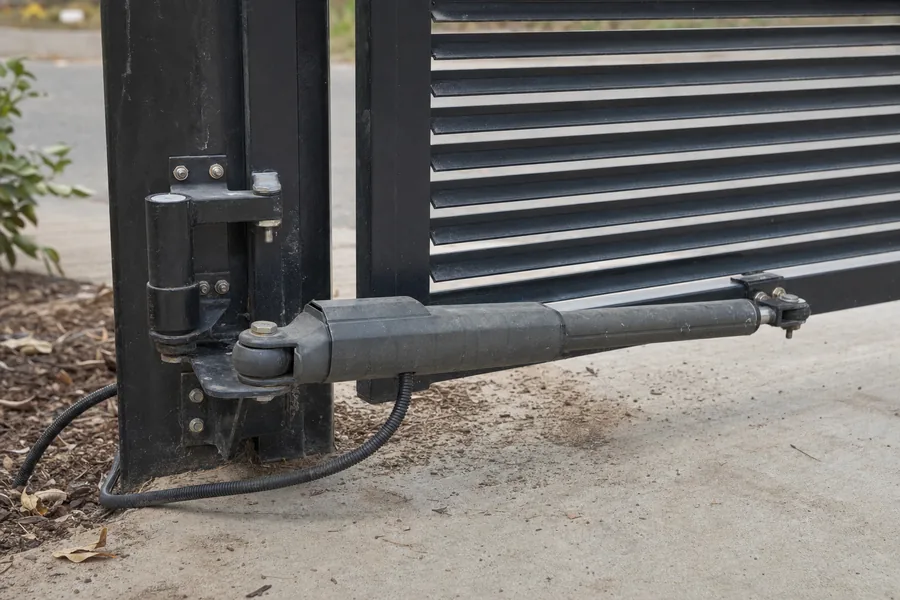
Swing gate operators push and pull an arm; slide gate operators turn a sprocket against a chain or a gear against a rack. Both have the same board, the same safety devices and the same controls, and both are mostly repaired with the same short list of parts.
Underground swing units are the exception. They sit in a box at the hinge and they flood, so their failures are seals and water before anything electrical.
Two-hour window, a call before the technician sets off, and a method that starts at the power and ends at the remote in your glovebox.
north Texas heat and hail wears on electronics faster than most people expect. Heat cooks capacitors and batteries, storms take boards, damp takes keypads and loop wiring, and the first cold snap finds every tired battery in Lewisville on the same morning.
Housings that were sealed ten years ago are not sealed now. A good part of every winter visit is water where it should not be.

Most operator faults are one part. A new unit is the right call when the make is orphaned and the board cannot be had, when the operator was too small for the gate it was asked to move, or when the housing has been flooding and the electronics are green inside.
We size the replacement to the gate's weight and the traffic it sees, and we install it after the gate itself swings or slides freely by hand. An operator cannot fix a heavy gate; it just dies trying.
Residential and light commercial operators from LiftMaster, Nice Apollo, US Automatic, Viking, DoorKing, FAAC, Eagle, All-O-Matic, Elite, Ramset, Mighty Mule and Ghost Controls. If the make is not on that list we still come out; the method is the same and most parts are shared across brands.
The power light on the box, the breaker, the solar panel's shade and dirt, the photo eye lens, a second remote, and a gentle push on the released gate to feel whether it drags. Two minutes, and it tells the technician what to bring.
Please do not wire around a photo eye or an edge sensor to get the gate closing. It is the one shortcut that hurts people.
On an AC operator that is almost always the start capacitor, a small carried part. On a DC unit it is a low battery or a gate that has got too heavy to move. Either way it is a first-visit repair.
Nine times in ten it is a photo eye or safety edge doing its job for a bad reason. We test each device in turn rather than guess.
Yes. Battery, charge controller, panel connections and the operator itself. Most solar calls are a battery past its life or a panel in shade.
All the common makes and most of the uncommon ones. The board, safety devices and controls follow the same rules on every brand.
No. A safety device that is holding the gate open is doing its job, and the repair is to fix it, which is nearly always quicker than the argument. We put bypassed devices back before anything else.
Most days. A gate stuck open is a security problem and the schedule keeps room for it.
Yes, across Lewisville and the towns around it. The technician tells you what has failed and what it takes to put right, and no is a complete answer.
Around Lewisville, one call gets you a two-hour slot and a heads-up call before the technician sets off. We don't buy leads and nobody on a phone judges a door they can't see.
Free estimate across Lewisville, TX and the towns around it.
Describe it and you'll get a booking, not a guess. The visit and the estimate is free, anywhere in Denton County.
Prefer a voice? Call (972) 597-0686.
Tell us what the door is doing. Nothing begins until you've heard the number, and hearing it is free.