
Driveway gates that drag, stall, hum or will not close, repaired the same day, operator and gate together.
Tell us what the door is doing. Nothing begins until you've heard the number, and hearing it is free.
A stuck driveway gate is a car that cannot leave, or a property standing open to the street. Either one gets a same-day visit in Lewisville. We repair the gate, the operator, the arm or chain, the hinges and the access controls, and we put the safety devices right before we go.
The work covers swing gates on linear or articulated arms, sliding gates on a ground track or a cantilever. Iron, steel and aluminum, on any operator that is still made and most that are not.
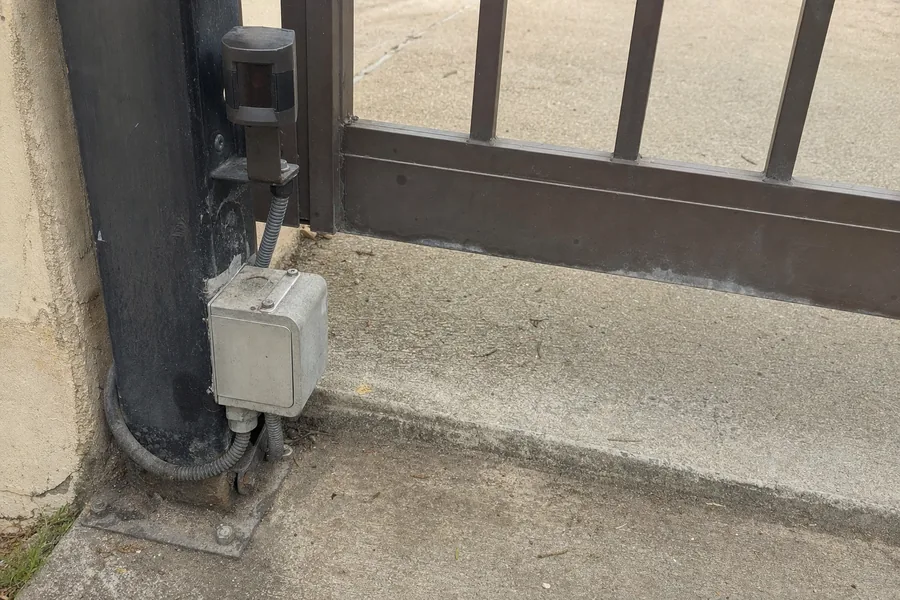
When a gate stops, the operator gets the blame. Sometimes it deserves it. More often one of these smaller things is the real fault, and it is a part and an hour rather than a new machine.
Outdoors, everything on a gate is a weather part. Around Lewisville, hail season and 100-degree summers punish panels and seals, and a gate operator has the same steel, the same lubricant and the same electronics, sitting in a box at the end of the driveway. Batteries lose capacity in the cold, boards take the surges, and grit gets into everything that turns.
Wind is the one that surprises people. A solid-panel leaf is a sail, and a strong gust on a half-open gate bends arms and rips brackets off posts. Where north Texas heat and hail are part of the year, a swing gate with solid infill needs stronger hardware than the operator's brochure suggests.
Every operator has a force setting. The gate binds, the force goes up, the safety reversal gets less sensitive, and the motor runs hot. On a sliding gate it is the rollers and the track: a flat spot on a wheel or a pebble in a V-track doubles the load on the chain and gear. The operator was never the problem. It was the last thing to break.
That is why the first ten minutes of a gate visit look nothing like an electrical job. Arm released, gate moved by hand, hinges and rollers checked, post checked for movement. Whatever we find there decides what the operator needs, if anything.
The operator is only half the system. The other half is whatever tells it to move: remotes, keypads, vehicle loops, intercoms, phone entry, a smartphone app. Each has its own way of failing, and each is quicker to prove than the guesswork of replacing the operator to fix a receiver.
We set up new remotes and codes, replace keypads and receivers, repair or re-cut exit loops, and bring older operators up to date where the board allows it. Photo eyes and edges are aligned and tested at the same time, because a gate that will not reverse is the one failure that matters.
Most gate repairs are done in the same visit because the parts that fail are the parts we carry.
Most residential gates here run on LiftMaster, Mighty Mule, Nice or Apollo, Viking, DoorKing, Linear, Elite, FAAC, GTO or Ghost Controls. We service all of them and replace the ones that cannot be saved. The parts that fail most, boards, batteries and arms, travel with us for the brands we see most in Lewisville.
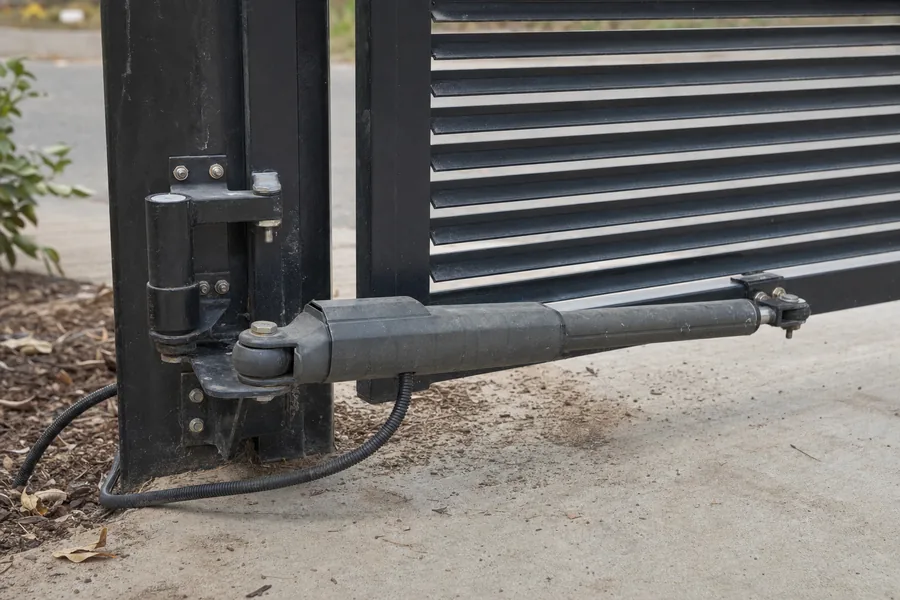
The question we get most is whether the old operator is done. Usually it is not. Boards, batteries, transformers, arms, chains and gears are all parts, and on the common brands we carry them. What ends an operator is a burned motor, a discontinued brand, or a machine that was too small for the gate from the day it went in.
If it is replacement, the new unit is chosen for the gate as it is, and the gate is made to swing free first. A correctly sized operator on a balanced gate is the whole difference between a repair every spring and one visit.
Power at the operator, the remote's battery, and whether anything is standing between the photo eyes. Those three clear a surprising number of calls before we set off, and we will happily walk you through them on the phone. If you need the car out now, use the manual release rather than pushing the leaf, which bends arms and strips gears.
If the gate is stuck open, tell us. That moves the visit up the list, because a property open to the street is the same urgency as a garage door that will not close.
Nine times out of ten a photo eye or safety edge. Something is in the beam, the eye has been knocked out of line, or it has failed. It is a safety device doing its job, and it is a quick fix.
Most of the time, yes. The parts that fail most often are on board for the brands we see most. Where something has to be ordered you hear it from the technician on the spot.
We treat it as one. A property open to the street gets the same priority as a garage door that will not close, and if the gate cannot be fixed that visit it is secured shut until it can.
Most of the time. Operators fail in parts, and parts get replaced. The exceptions are a cooked motor, a discontinued brand, and an operator that was undersized for the gate to begin with.
Yes, if the gate swings or slides freely by hand and the posts are sound. We check both first, because an operator on a gate that binds does not last.
Yes, and receivers, intercoms, phone entry and loop detectors as well. Control faults are a large share of gate calls and rarely need a new operator.
More, if anything, because they live outdoors. Once a year: hinges and rollers lubricated, track cleared, battery tested, photo eyes and reversal checked, force settings confirmed.
Around Lewisville, one call gets you a two-hour slot and a heads-up call before the technician sets off. We don't buy leads and nobody on a phone judges a door they can't see.
Free estimate across Lewisville, TX and the towns around it.
Describe it and you'll get a booking, not a guess. The visit and the estimate is free, anywhere in Denton County.
Prefer a voice? Call (972) 597-0686.
Tell us what the door is doing. Nothing begins until you've heard the number, and hearing it is free.